Regulatory Impact AssessmentAnalysis
Regulatory Impact AssessmentAnalysis
Anatomy of a Good RIA
Eight steps that make a Regulatory Impact Assessment truly help decision-makers, from defining the problem to ex post evaluation, with examples from two RIAs carried out at Brazil's electricity regulator.
During the review of the Research and Development Program at the Brazilian Electricity Regulatory Agency (Agência Nacional de Energia Elétrica, ANEEL), our team faced a choice that would help shape the future of research and innovation investment in Brazil’s electricity sector. Should we build gradually on the existing regulation, or propose a more substantial change in how projects were organized and evaluated? [1]
At the time, I was Deputy Coordinator of the Research and Development Program. Together with my colleagues in the coordination team, we led the development of the Regulatory Impact Assessment (RIA), known in Brazil as Análise de Impacto Regulatório (AIR), that would underpin this transformation. We conducted studies, took part in training, and held extensive discussions to establish a sound technical basis for the decision. The challenge was to move beyond an approach focused primarily on evaluating individual projects toward portfolios also oriented toward innovation, without losing the scientific and technological achievements the program had already delivered.
There was resistance to change. An intermediate option would have preserved much of the previous model and therefore appeared to offer a less disruptive transition. In our team’s assessment, however, it projected many of the same outcomes already being achieved. If our goal was to strengthen the program’s ability to generate innovation, what tangible improvement could we expect from a solution that retained much of its limitations?
This question helped us distinguish an easier implementation path from an alternative capable of changing the intended outcomes. RIA Report No. 002/2020-SPE/ANEEL compared four alternatives, numbered 0 through 3: the existing R&D model; its expansion to include innovation instruments (R&D+I); the E3P model, based on Estratégia, Portfólios, Programas e Projetos (Strategy, Portfolios, Programs, and Projects); and an option based on proofs of concept (PoCs). In the multi-criteria comparison using the Analytic Hierarchy Process (AHP), applied to the three change alternatives, E3P received an overall preference weight of approximately 56.5%, based on the criteria and weights adopted. This percentage represents a relative priority within the model. It is not a probability of success [1].
The decision to adopt E3P guided the development of the new Procedimentos do Programa de Pesquisa, Desenvolvimento e Inovação (PROPDI), the Procedures for the Research, Development, and Innovation Program, approved by ANEEL Normative Resolution No. 1,045/2022. Choosing a more substantial transformation did not mean overlooking implementation challenges or dispensing with transitional provisions. It meant setting the regulatory direction first and then planning how to put it into practice [1][2].
Shortly afterward, we took part in developing the RIA for the Plano Estratégico Quinquenal de Inovação (PEQuI), the Five-Year Strategic Plan for Innovation. RIA Report No. 001/2023-SPE/ANEEL compared maintaining the status quo, a communications plan, public recognition of innovative companies, and establishing PEQuI. The assessment used multi-criteria analysis and examined regulatory costs; the last alternative was recommended [3].
In this work, we needed to consider innovation outcomes, economic costs, social and environmental impacts, and regulatory changes. One of the challenges I remember most clearly was selecting 20 innovation indicators from a study that contained 120. That choice would largely determine how the program’s results would be monitored. This figure comes from my professional experience, not from the published documents, as do the descriptions of the discussions, brainstorming sessions, and stakeholder engagement from the initial call for input through the public consultations.
The work also included a strategic foresight exercise. Over approximately 12 months, we developed Inovælétrica 2040, comprising four exploratory scenarios for possible futures of the electricity sector through 2040. Technical Note No. 0001/2023-SPE/ANEEL documents the exercise, the workshops, the information-gathering process, and the use of its findings in formulating PEQuI’s strategic guidelines. The results are also part of the plan’s supporting documentation [4][5].
ANEEL Normative Resolutions No. 1,045/2022 and No. 1,074/2023 received the Gold Seal for Good Regulatory Practices from Brazil’s Ministry of Development, Industry, Trade and Services (MDIC) in 2023 and 2024, respectively. An important distinction: the awards were conferred on the regulatory instruments, not on the RIAs or their authors separately [2].
Taking part in these two processes after completing a postgraduate specialization in Regulatory Impact Assessment at the University of Brasília was gratifying. More important for the discussion here, however, was recognizing how much an RIA demands technical expertise, teamwork, and a willingness to challenge the team’s own assumptions.
In the previous article, Regulatory Impact Assessment: Why Sound Decisions Come Before Regulation, we discussed the history and purpose of this tool. Now the question is different: what needs to work within an RIA for it to genuinely support better decisions?
The Brazilian Framework and the Sources Used
Brazil’s Decree No. 10,411/2020 establishes the core content and procedures for RIAs within the federal public administration. Article 6 requires the identification of the problem and its causes, affected groups, legal basis, objectives, alternatives, and their impacts. It also covers stakeholder engagement, international experience, risks, comparison of alternatives, and an implementation strategy, as well as an executive summary and specific attention to effects on microenterprises and small businesses [6].
Meeting these requirements is necessary, but not sufficient. A report may contain every required heading yet still fail to explain why the recommended alternative is preferable to the others.
To develop the methodological discussion, we can take as our main references the Organisation for Economic Co-operation and Development’s (OECD) Regulatory Impact Assessment principles, published in 2020, and the European Commission’s Better Regulation Toolbox, updated in December 2025. The OECD publication places RIA within the decision-making process and emphasizes proportionality, alternatives, evidence, governance, and stakeholder engagement. The European Toolbox provides 69 tools addressing specific analytical questions, from problem definition to ex post evaluation [7][8].
Australia’s experience also provides a useful framework: the Australian Government Impact Analysis Framework, effective July 2026, organizes assessment around seven questions: what the problem is, what the objectives are, what options exist, what the net benefit of each one is, who was consulted, which option is best and how it will be implemented, and how it will be monitored and evaluated. For economic appraisal, Canada’s cost-benefit analysis guide for regulatory proposals is particularly relevant because it deals directly with regulation [9][10].
Why Rely So Extensively on UK Guidance?
The United Kingdom maintains four government guides serving complementary purposes. The Green Book provides guidance on ex ante appraisal of options, costs, benefits, and risks; the Magenta Book addresses evaluation of interventions and how to plan for future learning; the AQuA Book covers analytical quality assurance; and the Orange Book deals with risk management [11][12][13][14].
Taken together, these guides are useful because they connect the initial decision with implementation and review of outcomes. They are also public, detailed, and regularly updated. This does not make them Brazilian legal requirements: the Green Book, for example, is a general government appraisal guide, while the United Kingdom has separate regulatory guidance under its Better Regulation Framework. UK economic parameters, institutional mandates, and procedures should not be transplanted automatically into the Brazilian context [15].
Accordingly, Brazilian law remains this article’s legal foundation; the OECD provides RIA principles; the European Commission offers detailed guidance for each stage; and the UK guides help address economic appraisal, risk, quality, and outcomes. Brazilian sources allow us to examine these ideas against actual institutional experience.
We organize the anatomy into eight stages for clarity. They are not a rigid sequence: new evidence may require revisiting the problem, objectives, or alternatives themselves.
1. Define the Regulatory Problem and Understand Its Causes
The first question is: what undesirable situation needs to be addressed, and why is it happening?
Consider a hypothetical example from the electricity sector. Customers in a particular region experience prolonged power outages. The immediate response might be to increase penalties or impose stricter technical standards. But that would presume that the problem stems from inadequate rules, a hypothesis that still needs to be examined.
Possible causes include aging infrastructure, inadequate maintenance, weather events, access difficulties, or economic incentives. A single occurrence may result from several of these factors together. Tool No. 13 of the European Toolbox provides guidance on defining the problem, identifying its causes and consequences, and testing that explanation against available evidence. The OECD recommends starting RIA before a regulatory response has been settled [8][7].
A recurring pitfall is defining the problem as the absence of the preferred solution: “there is no regulation” or “the rule needs to be updated.” Such statements may identify an administrative action, but they do not, by themselves, establish a harm, its extent, or the mechanisms causing it.
Practical step. Build a map of causes, the central problem, and consequences. Link each causal relationship to a source of information, distinguishing observed facts from hypotheses that remain to be tested. Administrative data, studies, interviews, and stakeholder experience may complement one another.
Collaborative techniques can help structure this map. The Apostila AIR Facilitada (Facilitated RIA Workbook), by Thelma Maria Melo Pinheiro, presents a Brazilian approach to conducting RIA stages using facilitation and Design Thinking techniques. Its contribution here is to help organize team discussions. Verifying the causes still depends on evidence [16].
Quality check. Does the analysis distinguish symptoms from causes? Does it establish the extent of the problem, who is affected, and why intervention might be warranted? Does it identify causal relationships that remain uncertain?
This is not a trivial question. Saab and Silva (2022) assessed 21 RIAs prepared by Brazilian federal regulatory agencies between April and December 2021, using 50 criteria. On a scale from zero to five, problem definition scored an average of 2.57, while identifying the nature of the problem scored 0.48 and identifying the root cause scored 0.38. This is a snapshot of the first year of mandatory federal RIA. It is not a permanent diagnosis of all Brazilian RIAs [17].
2. Establish the Baseline and Explore Possible Futures
The second question is: what would probably happen without the new intervention?
This is the baseline scenario, or counterfactual baseline, addressed in Tool No. 60 of the Toolbox and in the Green Book. It is not a static snapshot of the present. It must account for investments already committed, existing regulations, technological changes, demand growth, and other factors that could change the problem even without the new measure [8][11].
In the power-outage example, if the utility is already making investments likely to improve service continuity, attributing every future improvement to a new rule would overstate its benefits. The comparison must focus on the alternative’s incremental effects relative to a plausible trajectory without it.
Inovælétrica 2040 and Strategic Foresight
There is another family of scenarios, serving a different purpose: foresight scenarios. They explore plausible futures, particularly when long-term decisions may be affected by technological, economic, and institutional uncertainty. The Toolbox covers strategic foresight in Tool No. 20 [8].
Inovælétrica 2040, developed during the preparation of PEQuI, is a Brazilian example. Technical Note No. 0001/2023-SPE/ANEEL records four exploratory scenarios through 2040, resulting from approximately 12 months of work involving workshops, data collection, surveys, and participation from different organizational units. One scenario was called Indústria Nacional 5.0 (National Industry 5.0) [4][5].
There is a parallel with the European Commission’s Joint Research Centre. In 2023, the EU Policy Lab presented four Reference Foresight Scenarios for Europe in 2040, developed with more than 100 experts over approximately two and a half years. The purpose was to explore plausible futures and test the robustness of policy proposals under different conditions [18].
The comparison is useful, but requires conceptual precision. Foresight scenarios are not automatically the same as the counterfactual baseline used in RIA. The former explore possible futures; the latter estimates what would happen without the intervention under assessment. They may complement each other, for example when different futures are used to stress-test an alternative, provided the counterfactual and underlying assumptions remain explicit.
Practical step. Establish a baseline with documented assumptions. For decisions sensitive to long-term change, add alternative future scenarios and assess how each option performs under them.
Quality check. Does the report distinguish changes that would occur without the new rule from those the rule could bring about? Are the scenarios internally coherent and used to compare options rather than merely illustrate the future?
3. Identify Affected Stakeholders and Set Measurable Objectives
The same problem can affect groups differently. An investment requirement, for example, may impose costs on regulated firms, create benefits for customers, and affect rates, competition, innovation, or the environment. Smaller organizations may face proportionately higher burdens when compliance involves substantial fixed costs. Brazil’s Decree requires affected groups to be identified and impacts on microenterprises and small businesses to be examined specifically [6].
Objectives, too, must describe outcomes, not just activities. “Issue a regulatory resolution” is an administrative output; “reduce avoidable outages” describes an intended change. Tool No. 15 of the Toolbox addresses objective-setting, while Tool No. 23 covers the small and medium-sized enterprise (SME) test [8].
In PEQuI, translating broad innovation objectives into performance measures presented a concrete challenge. In our team’s experience, one study compiled 120 indicators, from which 20 had to be selected. The indicators chosen would shape how results were interpreted and could influence regulated entities’ future decisions. PEQuI’s documentation records the plan’s emphasis on objectives and indicators, while the figures describing the selection process come from my experience on the team [3][5].
The agency’s legal authority must also be considered. A problem may have important causes that the regulator cannot address on its own, or that require coordination with other institutions.
Practical step. Prepare a matrix linking affected groups, the nature and intensity of impacts, general and specific objectives, expected outcomes, indicators, data sources, and the corresponding legal authority.
Quality check. Are causes and objectives logically connected? Can success be assessed using relevant indicators rather than merely confirming completion of administrative activities? Does the analysis include underrepresented groups?
4. Develop Alternatives That Can Genuinely Compete for the Recommendation
RIA loses value when it compares a predetermined solution against vague, implausible, or poorly examined options. Article 6 of Decree No. 10,411/2020 requires consideration of the no-action option, regulatory solutions, and, wherever possible, nonregulatory solutions. Tools Nos. 16 and 17 of the Toolbox address the identification of options and the choice of policy instruments, respectively [6][8].
In PROPDI, the differences between alternatives were substantive. Retaining the previous model, adding instruments to the existing program, adopting E3P, or emphasizing proofs of concept represented different paths for encouraging innovation. The transitional alternative deserved consideration, but our team found that its projected results were not sufficiently different from those already achieved under the previous regulation. The choice of E3P sought to address that limitation [1].
In PEQuI, maintaining the status quo, introducing a communications plan, publicly recognizing innovative companies, and establishing the strategic plan likewise relied on different mechanisms. Communication can improve information flows; recognition can create reputational incentives; and a strategic plan can establish targets and indicators to guide portfolios. The RIA recommended the last option after comparing impacts and costs [3].
Practical step. Develop genuinely different options. For each one, explain its mechanism, legal feasibility, implementation requirements, expected outcomes, and possible combinations with other measures. Provide documented reasons for discarding alternatives.
Quality check. Are the options real contenders for the recommendation? Is the no-action option defined consistently with the baseline? Does the assessment avoid giving the preferred proposal much more detailed treatment than the others?
5. Identify, Estimate, and Distribute Impacts
Once each alternative’s mechanism has been described, the next task is to assess what changes for each affected group. Tool No. 18 of the Toolbox provides guidance on identifying impacts; Tools Nos. 56 through 59 cover the typology of costs and benefits, methods to assess them, the Standard Cost Model, and cost estimates under the one in, one out approach. Canada’s 2022 guide complements these tools with recommendations specifically for regulatory proposals [8][10].
Some effects can be monetized. Others are initially expressed in physical units or environmental and social indicators: hours of outages avoided, emissions, safety, service quality, effects on innovation, and so forth.
It is essential to distinguish private costs, transfers, and net economic costs to society. A financial transfer between groups is not necessarily an additional social cost. Double counting related outcomes must also be avoided.
Compliance costs include burdens associated with adapting to regulatory obligations. Within this category, administrative costs arising from information requirements can, in part, be estimated using the Standard Cost Model. That tool does not, by itself, account for all regulatory costs.
The distribution of impacts deserves separate examination. A favorable aggregate result may coexist with substantial losses for smaller firms, vulnerable customers, or particular regions. The Brazilian Decree requires special attention to microenterprises and small businesses [6].
Practical step. Develop a matrix of alternatives by impact category and affected group. For each effect, record its direction, magnitude, time horizon, data, assumptions, and uncertainties. Monetize effects where there is an adequate technical basis; otherwise use physical units and well-supported qualitative assessments.
Quality check. Are impacts incremental relative to the baseline? Are relevant costs included for every alternative? Are nonmonetized effects and distributional impacts transparent? Can the figures be reproduced?
In Saab and Silva’s sample, the criterion concerning the use of evidence to assess impacts averaged 0.90 out of five. Quantification is not always mandatory. Even so, the empirical basis for estimated impacts deserves serious scrutiny [17].
6. Select the Comparison Method and Test Its Robustness
The central question at this stage is: how can consequences of different kinds be compared, and how can the recommended option be justified?
Article 7 of Decree No. 10,411/2020 provides for six methods: multi-criteria analysis (MCA), cost-benefit analysis (CBA), cost-effectiveness analysis (CEA), cost analysis, risk analysis, and risk-risk analysis. The method selected must be justified, and another method may be used when its suitability for the specific case is demonstrated. The provision does not establish an overarching hierarchy among these methods [6].
How the Methods Relate to One Another
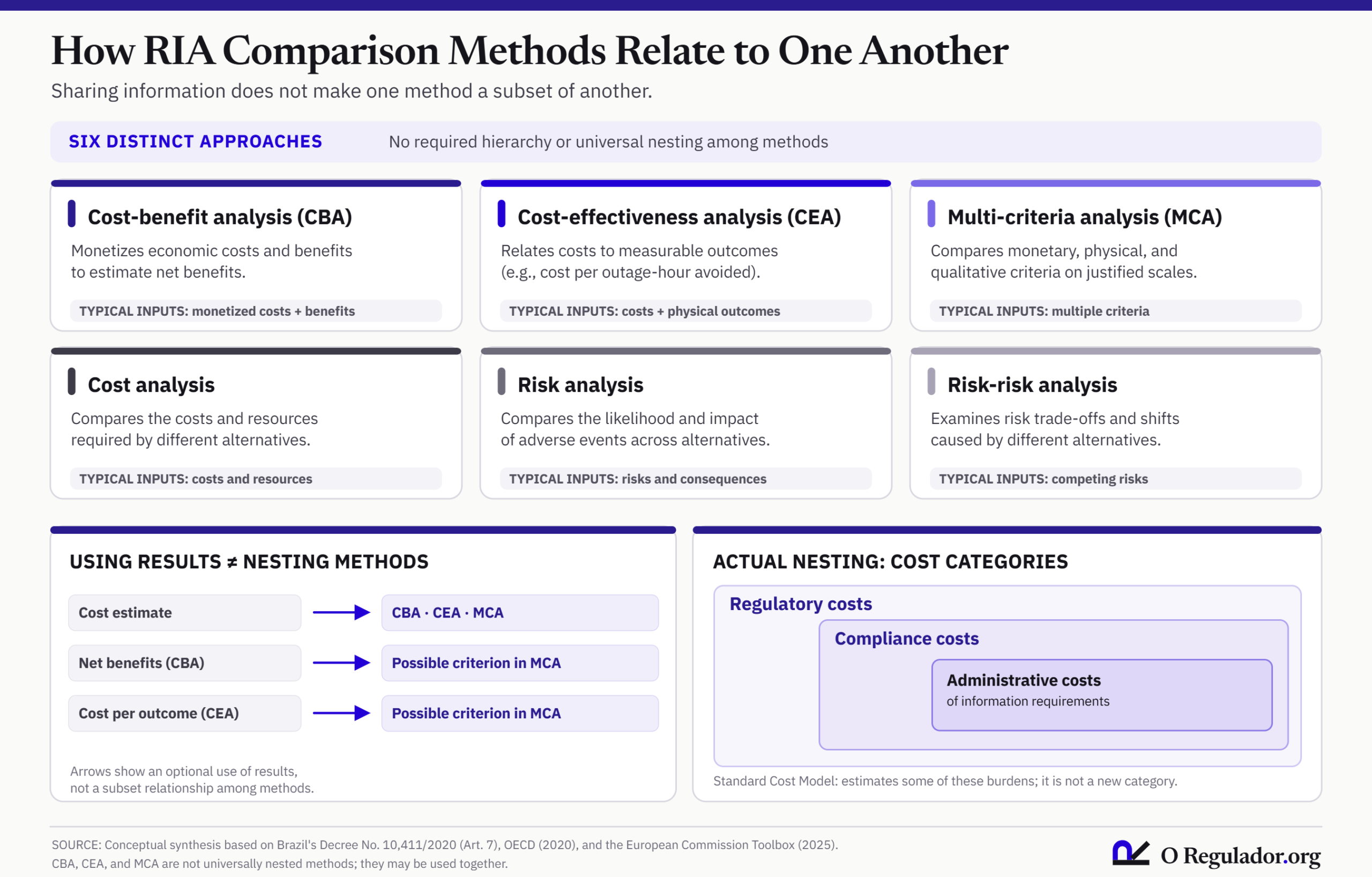
It is important to distinguish relationships among methods from relationships among categories of information. MCA may use a CBA or CEA result as one of its criteria, but that does not make those methods subsets of multi-criteria analysis. By contrast, administrative costs associated with information requirements may be a component of compliance costs.
CBA seeks to identify and, where technically defensible, monetize economic costs and benefits, comparing incremental outcomes over time. The Green Book, the Canadian guide, and Tool No. 63 of the Toolbox help structure this appraisal. Relevant nonmonetized effects must still be reported [11][10][8].
CEA relates costs to units of outcome or to achieving a comparable target. It may be suitable for estimating the incremental cost per hour of outage avoided, provided the alternatives’ outcomes are sufficiently comparable.
MCA integrates different economic, technical, social and environmental, and institutional criteria. Tool No. 62 of the Toolbox discusses this approach. It requires relevant criteria, clear scales, defensible weights, and sensitivity analysis. A table of arbitrary scores does not become a sound assessment merely because it is labeled multi-criteria [8].
AHP, used in the PROPDI and PEQuI RIAs, is a multi-criteria decision method that organizes criteria and alternatives into a hierarchy and relies on pairwise comparisons. The 56.5% preference weight for E3P in the PROPDI RIA emerged from this framework of judgments and weights [1][3].
Cost analysis focuses on comparing the resources each alternative requires and may be appropriate when expected outcomes are sufficiently equivalent. Risk analysis examines uncertain consequences and their probabilities; risk-risk analysis helps determine whether reducing one hazard may increase another. Their suitability depends on the regulatory problem.
Uncertainty and sensitivity analysis, covered in Tool No. 65 of the Toolbox, should accompany the primary methods whenever assumptions may change the decision. It can involve scenarios, ranges, tests of weights, and the identification of critical values [8].
Practical step. Select the method after identifying impacts and assessing data quality. Justify the choice and document calculations, scales, criteria, weights, and the treatment of nonmonetized effects.
Quality check. If plausible assumptions change, does the ranking of alternatives remain the same? If not, does the recommendation clearly disclose this weakness? Can an independent reader reconstruct the decision process?
Saab and Silva found an average score of 0.90 for the criterion concerning the comparison method and 0.38 for the justification of its selection, both on a zero-to-five scale. What weighs is the lack of rigor in how methods are applied, whether they are qualitative or quantitative [17].
7. Engage Stakeholders and Ensure Analytical Quality
Stakeholder engagement allows regulators to test their assumptions against information the team may not have. Customers can reveal consequences not readily visible in administrative datasets; companies can provide operational cost information; and researchers may challenge assumptions and causal relationships.
Chapter 7 of the Toolbox, particularly Tools Nos. 51 through 55, addresses consultation strategies, the conduct of engagement activities, the treatment of information received, and transparency. The OECD recommends engagement from the early stages, while there is still scope to reconsider the problem definition and develop alternatives [8][7].
In the PROPDI and PEQuI processes, we used participatory mechanisms from the initial calls for input through the public consultations on the assessments and proposed regulations. This openness neither eliminates disagreements nor requires an authority to accept the majority view. It does, however, create an analytical responsibility to examine relevant contributions and explain the rationale for decisions.
The Brazilian Decree distinguishes stakeholder participation specifically concerning the RIA (Article 8) from public consultation on the proposed regulation (Article 9), subject to the exceptions in Article 9-A. These stages have partly different purposes: the former may address the problem and its alternatives, while the latter also examines the specific provisions of the proposed rule [6].
Stakeholder engagement broadens scrutiny, but it is not a substitute for analytical quality assurance. The AQuA Book distinguishes verification of calculations and procedures from validation of whether an analysis is fit for the decision it is intended to support. A spreadsheet can be mathematically correct while modeling the wrong problem [13].
Brazil’s Experience in Assessing RIA Quality
Brazil’s National Water and Basic Sanitation Agency (Agência Nacional de Águas e Saneamento Básico, ANA) developed the RIA Quality Indicator (IQAIR), documented in a paper presented at the 13th Brazilian Congress on Regulation. The instrument comprises 12 criteria and 24 subcriteria, with weights and ratings for full, partial, or noncompliance with each criterion. To reduce subjective differences, each RIA is assessed by at least two staff members, and a third one decides when there is no consensus [19].
According to ANA’s institutional website, seven RIAs completed in 2025 achieved an average score of 97.06 points on a scale from zero to 100. The figure reflects performance against the indicator’s criteria; it does not, on its own, establish that the associated regulatory decisions produced the best possible outcomes [20].
Brazil’s National Confederation of Industry (Confederação Nacional da Indústria, CNI) also published a methodology for assessing RIA quality in 2026, contributing to the discussion of criteria and measurement. However, a methodological quality rating does not automatically establish the legal validity or invalidity of a regulatory act [21].
Practical step. Plan stakeholder engagement from the outset, identify underrepresented groups, record submissions and responses, preserve successive versions of studies, and subject critical elements to technical review proportionate to the risks involved.
Quality check. Were submissions meaningfully considered and responded to? Can the data and models be verified? Does the report allow its underlying assumptions to be examined without relying solely on personal trust in the analyst?
8. Plan Implementation, Monitoring, and Ex Post Evaluation
The final question is: how will the chosen alternative produce its intended outcomes, and how will we know whether it did?
A recommendation may look attractive on paper yet encounter practical implementation barriers. Responsibilities, resources, timelines, transitional measures, information systems, and risks must be defined. Tool No. 38 of the Toolbox addresses promoting and checking compliance; Tool No. 43 covers monitoring arrangements and indicators; and Tools Nos. 46 through 48 provide guidance on designing and conducting ex post evaluations [8].
A theory of change, or logic model, helps connect resources, activities, outputs, behavioral changes, and outcomes. Issuing a resolution is an output; changing investment decisions or improving service quality are outcomes that depend on additional mechanisms.
The Orange Book helps link risks and objectives; the Magenta Book provides guidance on planning evaluation from the outset. Tracking indicators is not the same as identifying the causal effect of regulation: an indicator may improve because of external factors, earlier measures, or a combination of causes [14][12].
PEQuI illustrates an effort to connect strategic planning, indicators, and portfolio monitoring. The Inovælétrica 2040 scenarios broadened the planning horizon, but ex post evaluation will still require suitable data and methods to investigate the effects actually observed [3][4][5].
Roberta Chamusca’s July 2024 presentation on good regulatory practices at Brazil’s National Land Transportation Agency (Agência Nacional de Transportes Terrestres, ANTT) illustrates the importance of internal procedures, methodological support, monitoring instruments, and a schedule for Avaliação de Resultado Regulatório (ARR), Brazil’s ex post evaluation of regulatory outcomes. This institutional dimension complements the technical design of each report [22].
In Brazil, Decree No. 10,411/2020 provides for integrating ARR into the regulatory process and establishes a specific requirement for evaluation within three years when the RIA was waived on grounds of urgency [6].
Practical step. Prepare an implementation plan specifying responsible parties, costs, risks, timelines, indicators, and data sources. Develop a logic model and plan the questions and methods for subsequent evaluation.
Quality check. Will it be possible to distinguish an observed change from an effect attributable to the intervention? Was data collection planned before implementation? Are there mechanisms to adjust the regulation when actual outcomes differ from expectations?
What, Ultimately, Makes a Good RIA?
The anatomy of an RIA can be described in parts, but its quality emerges from the relationships among them. A poorly defined problem undermines the objectives. Vague objectives weaken the selection of indicators. Artificial alternatives make the comparison a foregone conclusion. Weak estimates may lend false precision to a recommendation. And an intervention without adequate monitoring limits opportunities to learn.
International references help structure the reasoning. The OECD provides principles directly related to RIA; the European Commission details tools for different analytical challenges; Canada contributes guidance on the economic appraisal of regulations; and the UK guides offer depth on ex ante appraisal, risks, quality assurance, and ex post evaluation [7][8][10][11][12][13][14].
Brazilian experience reveals both opportunities and limitations. Saab and Silva’s research identifies weaknesses in a defined sample of reports; ANA’s IQAIR provides a means of assessing content quality; and ANTT’s practices illustrate the institutional work required to sustain RIA and ex post regulatory evaluation [17][19][22].
My experience with the PROPDI and PEQuI processes left me with a practical lesson: assessment fulfills its purpose only when we are willing to reconsider what initially seems easier or more convenient. In PROPDI, that meant questioning a transition whose expected results were too similar to those of the existing model. In PEQuI, it meant working with multiple criteria, indicators, and views of the future to support a broader strategic direction.
A good RIA does not eliminate every uncertainty. It makes clear what is known, what remains a hypothesis, why one alternative appears preferable, and under what conditions that conclusion might change.
By the time we finish reading a report, we should be able to reconstruct the answers to four questions: what problem justified the assessment; what alternatives could address it; what evidence supported their comparison; and how outcomes will be observed after the decision.
When those answers are clear, RIA moves beyond being a documentation exercise and approaches its central purpose: helping public authorities make better decisions while enabling society to scrutinize the reasons behind those decisions.
References
- BRAZILIAN ELECTRICITY REGULATORY AGENCY (ANEEL). Relatório de Análise de Impacto Regulatório nº 002/2020-SPE/ANEEL. [Regulatory Impact Assessment Report No. 002/2020-SPE/ANEEL: Incorporating the Concept of Innovation and Other Measures to Improve Outcomes of the ANEEL-Regulated R&D Program]. Brasília, 2020. In Portuguese. Available at: https://www2.aneel.gov.br/cedoc/air2020002spe.pdf. Accessed on: October 20, 2026.
- ANEEL. Selo de Boas Práticas Regulatórias. [Good Regulatory Practices Seal]. Official list of ANEEL regulatory instruments awarded by MDIC, including Normative Resolutions No. 1,045/2022 (2023) and No. 1,074/2023 (2024). In Portuguese. Available at: https://www.gov.br/aneel/pt-br/assuntos/governanca-regulatoria/selo-de-boas-praticas-regulatorias. Accessed on: October 20, 2026.
- ANEEL. Relatório de Análise de Impacto Regulatório nº 001/2023-SPE/ANEEL. [RIA Report No. 001/2023-SPE/ANEEL: assessment of alternatives for the Five-Year Strategic Plan for Innovation (PEQuI)]. Brasília, January 19, 2023. In Portuguese. Available at: https://www2.aneel.gov.br/cedoc/air2023001spe.pdf. Accessed on: October 20, 2026.
- ANEEL. Nota Técnica nº 0001/2023-SPE/ANEEL [Technical Note No. 0001/2023-SPE/ANEEL], January 19, 2023. PEQuI public consultation, with Appendix 1, Scenario Development (Inovælétrica 2040 project). In Portuguese. Available at: https://antigo.aneel.gov.br/web/guest/consultas-publicas?p_p_id=participacaopublica_WAR_participacaopublicaportlet&p_p_lifecycle=2&p_p_state=normal&p_p_mode=view&p_p_cacheability=cacheLevelPage&p_p_col_id=column-2&p_p_col_pos=1&p_p_col_count=2&_participacaopublica_WAR_participacaopublicaportlet_ideDocumento=48889&_participacaopublica_WAR_participacaopublicaportlet_tipoFaseReuniao=fase&_participacaopublica_WAR_participacaopublicaportlet_jspPage=%2Fhtml%2Fpp%2Fvisualizar.jsp. Accessed on: October 20, 2026.
- ANEEL. Plano Estratégico Quinquenal de Inovação (PEQuI) 2024-2028. [Five-Year Strategic Plan for Innovation, 2024-2028]. Annex VIII to Normative Resolution No. 1,074/2023, corrected version. In Portuguese. Available at: https://www2.aneel.gov.br/cedoc/aren20231074_2_7.pdf. Accessed on: October 20, 2026.
- BRAZIL. Decreto nº 10.411, de 30 de junho de 2020. [Decree No. 10,411 of June 30, 2020: regulates regulatory impact assessment]. Consolidated text; see especially Articles 6 (content of the RIA), 7 (methodologies), 8, 9, and 9-A (public participation and consultation), 12 (ex post evaluation within three years after a waiver for urgency), and 13 (ex post evaluation). In Portuguese. Available at: https://www.planalto.gov.br/ccivil_03/_ato2019-2022/2020/decreto/d10411.htm. Accessed on: October 20, 2026.
- ORGANISATION FOR ECONOMIC CO-OPERATION AND DEVELOPMENT (OECD). Regulatory Impact Assessment. OECD Best Practice Principles for Regulatory Policy. Paris: OECD Publishing, 2020. Available at: https://doi.org/10.1787/7a9638cb-en. Accessed on: October 20, 2026.
- EUROPEAN COMMISSION. Better Regulation Toolbox. December 2025 version. See especially Tools No. 13, 15 to 18, 20, 23, 38, 43, 46 to 48, and 51 to 65. Available at: https://commission.europa.eu/law/law-making-process/better-regulation/better-regulation-guidelines-and-toolbox/better-regulation-toolbox_en. Accessed on: October 20, 2026.
- AUSTRALIA. OFFICE OF IMPACT ANALYSIS. Australian Government Impact Analysis Framework. In force since July 1, 2026. Available at: https://oia.pmc.gov.au/impact-analysis/australian-government. Accessed on: October 20, 2026.
- CANADA. TREASURY BOARD OF CANADA SECRETARIAT. Canada’s Cost-Benefit Analysis Guide for Regulatory Proposals. Ottawa, 2022. Available at: https://publications.gc.ca/collections/collection_2022/sct-tbs/BT58-5-2022-eng.pdf. Accessed on: October 20, 2026.
- UNITED KINGDOM. HM TREASURY. The Green Book (2026). UK government guidance on appraisal. 2026 edition. Available at: https://www.gov.uk/government/publications/the-green-book–2/the-green-book-2026. Accessed on: October 20, 2026.
- UNITED KINGDOM. HM TREASURY; EVALUATION TASK FORCE. The Magenta Book: Central Government Guidance on Evaluation. May 2026 edition. Available at: https://www.gov.uk/government/publications/the-magenta-book. Accessed on: October 20, 2026.
- UNITED KINGDOM. GOVERNMENT ANALYSIS FUNCTION. The AQuA Book. Revised edition, 2025. Available at: https://www.gov.uk/guidance/the-aqua-book. Accessed on: October 20, 2026.
- UNITED KINGDOM. HM TREASURY. The Orange Book: Management of Risk, Principles and Concepts. 2023 edition. Available at: https://www.gov.uk/government/publications/orange-book/the-orange-book-management-of-risk-principles-and-concepts. Accessed on: October 20, 2026.
- UNITED KINGDOM. DEPARTMENT FOR BUSINESS AND TRADE. Better Regulation Framework. Official guidance for the regulatory process, 2023, updated September 2025. Available at: https://www.gov.uk/government/publications/better-regulation-framework. Accessed on: October 20, 2026.
- PINHEIRO, Thelma Maria Melo. Apostila AIR Facilitada: promovendo a realização da AIR por meio da utilização de ferramentas colaborativas e de Design Thinking. [Facilitated RIA Workbook: Supporting Regulatory Impact Assessment Through Collaborative and Design Thinking Tools]. 1st ed. Brasília, August 2022. Training material, not published online. In Portuguese.
- SAAB, Flavio; SILVA, Suylan de Almeida Midlej e. Qual a qualidade da análise de impacto regulatório elaborada por agências reguladoras do Brasil? [How Good Are the Regulatory Impact Assessments Produced by Brazilian Regulatory Agencies?]. Revista de Administração Pública, v. 56, n. 4, p. 529-549, 2022. In Portuguese. Available at: https://doi.org/10.1590/0034-761220220111. Accessed on: October 20, 2026.
- EUROPEAN COMMISSION. JOINT RESEARCH CENTRE; EU POLICY LAB. Reference Foresight Scenarios: How to Futureproof EU Policies? September 13, 2023. Available at: https://policy-lab.ec.europa.eu/stories/reference-foresight-scenarios-how-futureproof-eu-policies-2023-09-13_en. Accessed on: October 20, 2026.
- COSTA, Raimisson Rodrigues Ferreira; GARCIA, Gustavo Cunha; MON-MA, Márcia Lika; RAVANELLO, Mariane Moreira. Indicador de Qualidade das Análises de Impacto Regulatório da Agência Nacional de Águas e Saneamento Básico (ANA). [Quality Indicator for Regulatory Impact Assessments at Brazil’s National Water and Basic Sanitation Agency (ANA)]. 13th Brazilian Congress on Regulation (ABAR), 2023. In Portuguese. Available at: https://www.gov.br/ana/pt-br/assuntos/governanca-regulatoria/analise-de-impacto-regulatorio-air/qair/artigo%20IQAIR.pdf. Accessed on: October 20, 2026.
- NATIONAL WATER AND BASIC SANITATION AGENCY (ANA). Indicador de Qualidade da AIR (IQAIR). [RIA Quality Indicator]. Methodology and results from 2020 to 2025. In Portuguese. Available at: https://www.gov.br/ana/pt-br/assuntos/governanca-regulatoria/analise-de-impacto-regulatorio-air/qair. Accessed on: October 20, 2026.
- NATIONAL CONFEDERATION OF INDUSTRY (CNI). Avaliação da qualidade das análises de impacto regulatório produzidas no Brasil: metodologia. [Assessing the Quality of Regulatory Impact Assessments Produced in Brazil: Methodology]. Report 2. Brasília: CNI, 2026. In Portuguese. Available at: https://static.portaldaindustria.com.br/media/filer_public/8d/20/8d20c929-eaf5-4ff6-a8dc-4cc4d43cbfb5/parte_2_metodologia_v3.pdf. Accessed on: October 20, 2026.
- CHAMUSCA, Roberta. Boas Práticas Regulatórias: Análise de Impacto Regulatório e Avaliação de Resultado Regulatório. [Good Regulatory Practices: Regulatory Impact Assessment and Ex Post Evaluation of Regulatory Outcomes]. Presentation at the Workshop on Innovation and Good Regulatory Practices in Transportation, ANTT, Brasília, July 2, 2024. Presentation not published online; event announcement available at: https://www.gov.br/antt/pt-br/assuntos/ultimas-noticias/antt-realizara-workshop-201cinovacao-e-boas-praticas-regulatorias-em-transportes201d. In Portuguese. Accessed on: October 20, 2026.
The opinions and analyses expressed in this article are personal and do not represent the institutional positions, decisions, or views of the Brazilian Electricity Regulatory Agency (ANEEL).
How to cite this article
ALCÂNTARA, Márcio. Anatomy of a Good RIA. Regulador.org, 2026. Available at: https://www.regulador.org/en/2026/10/22/anatomy-of-a-good-ria/. Accessed on: Oct. 22, 2026.
Dr. Márcio Alcântara
Electrical engineer with a master's degree and a PhD from UNICAMP. A civil servant at ANEEL since 2008. Writes about regulation as a discipline: how public decisions are built, what evidence supports them, and how they can be more transparent.