Regulatory Impact AssessmentAnalysis
Regulatory Impact AssessmentAnalysis
The Regulatory Problem Is Not a Missing Rule
A good Regulatory Impact Assessment starts by investigating what is wrong, not by choosing what to regulate. I show how to separate symptom, problem, cause and solution, and what a report survey reveals.
Imagine that complaints about electricity bills have increased by 30% in a single year. The figure is hypothetical, but the response is familiar: someone proposes revising billing regulations, expanding information-disclosure obligations or stepping up enforcement.
Which of these measures would be right? We do not know. The rise in complaints might reflect billing errors, tariffs that have become harder to understand, actual changes in prices, greater awareness of complaint channels, or some combination of these factors. It is even possible for the total number of complaints to rise while the complaint rate per customer falls.
The impulse to respond quickly is understandable. The problem arises when the response is chosen before we understand what it is supposed to address. At that point, Regulatory Impact Assessment (RIA; Análise de Impacto Regulatório, AIR, in Brazil) risks becoming a justification for a decision already made.
Brazil’s Decree No. 10,411/2020 defines RIA as a procedure that starts by defining a regulatory problem and then assesses, in advance, the likely effects of alternatives to issuing normative acts [1]. The order matters. The problem must guide the search for a solution, and the solution cannot serve as proof that the problem exists.
1. The question comes before the rule
Regulatory work often begins with a concrete request: update a resolution, establish rules for a new activity, harmonize procedures or create an obligation. Such requests may be legitimate, but on their own they do not tell us which undesirable outcome requires intervention.
The Organisation for Economic Co-operation and Development (OECD) regards defining the nature and extent of the problem as a fundamental step in RIA. It recommends examining objectives, alternatives, costs, benefits and monitoring arrangements, while involving affected parties throughout the process [2]. Having a good regulatory idea is not enough. It is necessary to show why that idea is preferable to other ways of addressing the situation.
The European Commission is even more explicit. Tool No. 13 of its Better Regulation Toolbox, December 2025 edition, warns against two recurring mistakes: treating the absence of a public policy instrument as an automatic problem, and working backward from a preferred option to construct a diagnosis that supports it. The Toolbox calls this second practice backward engineering. It also requires analysis of the problem’s scale, underlying drivers, affected groups and likelihood of persisting [3].
Brazil has similar guidance. The Regulatory Impact Assessment Guide published by the Office of the Chief of Staff (Casa Civil) in 2018 calls for clear boundaries around the problem and analysis of its nature, causes, consequences, extent and expected evolution without intervention. It discourages vague problem statements based solely on the absence or insufficiency of instruments, while recognizing that such deficiencies may form part of the diagnosis [4].
There is also a specific legal requirement. Article 6 of Decree No. 10,411/2020 requires, among other elements, identification of the problem, its causes and extent (item II); affected parties (item III); the legal basis for action (item IV); objectives (item V); and alternatives, including taking no action and, wherever possible, non-regulatory options (item VI) [1]. These are not independent bureaucratic boxes to be ticked. Together they form an argument that should remain coherent from beginning to end.
If the opening question is merely “which regulation should we issue?”, the range of alternatives is restricted from the outset. If we ask instead “what situation causes losses, risks or outcomes inconsistent with public objectives, and why?”, the analysis can uncover less obvious responses, including the possibility that no new rule is needed.
2. Symptoms, problems, causes and solutions are not the same thing
Return to electricity bills. “Complaints rose by 30%” describes an observable signal. “Recurring billing errors lead to incorrect charges” would be a possible central problem, provided the data supported it. “A failure in the metering process or in communication between systems produces those errors” would be a causal hypothesis. “Change the billing regulation” would be only one possible intervention. These are four different claims, and moving from one to the next requires investigation, not merely persuasive wording.
Consider another example, inspired by issues that arise in regulatory practice and used here solely as a teaching illustration. The first statement prescribes a solution: “Rules must be introduced to suspend unused authorizations.” The second identifies an outcome: “Inactive authorizations may reduce the formal availability of a scarce resource to new users.” The third invites investigation: “Reserving capacity for extended periods without actually using it may block new connections and investment; we need to determine whether authorization design, agents’ incentives or enforcement explain the phenomenon.”
The first sentence might appear in a regulatory agenda. The second already identifies something that could be observed. The third opens competing hypotheses and testable questions, although it does not, by itself, establish that the phenomenon exists or that regulation would be the best response.
This distinction also helps avoid the opposite mistake. Not every reference to a missing rule indicates a poor RIA. The absence of a rule can create legal uncertainty, disputes and costs. The point is to demonstrate the effects: which decisions lacked a clear standard, who was harmed, what costs arose and why existing arrangements failed to resolve the situation. A concrete institutional failure deserves analysis, even when its immediate cause is a regulatory gap.
3. What makes a problem regulatory?
Some undesirable situations lie beyond a regulator’s legal authority. Others may improve without further intervention. And in some cases the state itself, through its rules or procedures, contributes to the problem. In the economic theory of regulation, it is useful to examine at least three families of mechanisms.
Market failures come first. Information asymmetries may prevent consumers from assessing products or risks; externalities arise when decision-makers do not bear the full costs of their actions; market power may restrict access or raise prices; shared resources may create incentives for inefficient use. These hypotheses help explain why individually rational decisions can, taken together, generate socially undesirable outcomes.
The second family is government and regulatory failures. A rule may create incentives that run counter to its stated purpose; an obligation may impose disproportionate costs; rules issued by different institutions may conflict; enforcement may target relatively minor behaviors while leaving material risks unaddressed. In these cases, the diagnosis should identify the mechanisms generated by institutional design rather than merely state that a regulation is outdated.
The third is implementation and coordination problems. Sometimes existing rules already provide a basis for action, but difficulties remain with information, interagency coordination, operational capacity, inconsistent application or incentives to breach the rules. Before proposing a new resolution, it is reasonable to examine whether better enforcement of existing provisions, guidance to regulated parties or changes to administrative processes could resolve a substantial part of the problem.
A legal obligation is a separate consideration. If legislation requires an authority to regulate a particular subject, there is a duty to act. That does not remove the need to explain what is at stake and to compare the forms that regulation could take within the discretion the law allows. The obligation to regulate, the undesirable situation and the legal authority to act are related but distinct concepts [1][4].
The choice also has a political side. Researcher Deborah Stone argued that causal narratives influence whether problems reach the public policy agenda and who is held responsible for them [5]. Saying that a difficulty is caused by “uninformed consumers” points toward one set of responses. Saying that it results from information presented in a way that is hard to understand points toward another. Both factors may coexist, and RIA must investigate their relative importance rather than choose the more convenient narrative.
4. From apparent causes to the causes that matter
Defining the problem clearly is only the beginning of the diagnosis. The next question is why it happens.
One simple tool is the sequence of the “five whys.” Suppose an agency identifies excessive delays in resolving complaints. The first answer might be that many cases require rework. Why is rework necessary? Because the information received is incomplete or inconsistent. Why does it arrive that way? Because forms and systems collect different data. And why do they collect different data? Because different organizational units created their procedures without integration. Why was there no integration? Because no governance arrangement was established to review the process end to end.
This chain suggests a hypothesis about an underlying cause. It does not prove that the hypothesis is true. Alternative explanations might include a surge in demand, staff shortages, changes in the types of complaints or technology failures. If an empirical analysis shows that resolution times remain high even when cases contain complete information, the rework hypothesis becomes less convincing as the main explanation.
A problem tree develops this logic by separating the central phenomenon from its causes and consequences. In a schematic example, the potential causes would be incompatible processes, incomplete data and misaligned incentives. The central problem would be excessive delays, measured against a meaningful service standard. The possible consequences would be higher costs for users, accumulated disputes, loss of trust and potential litigation.
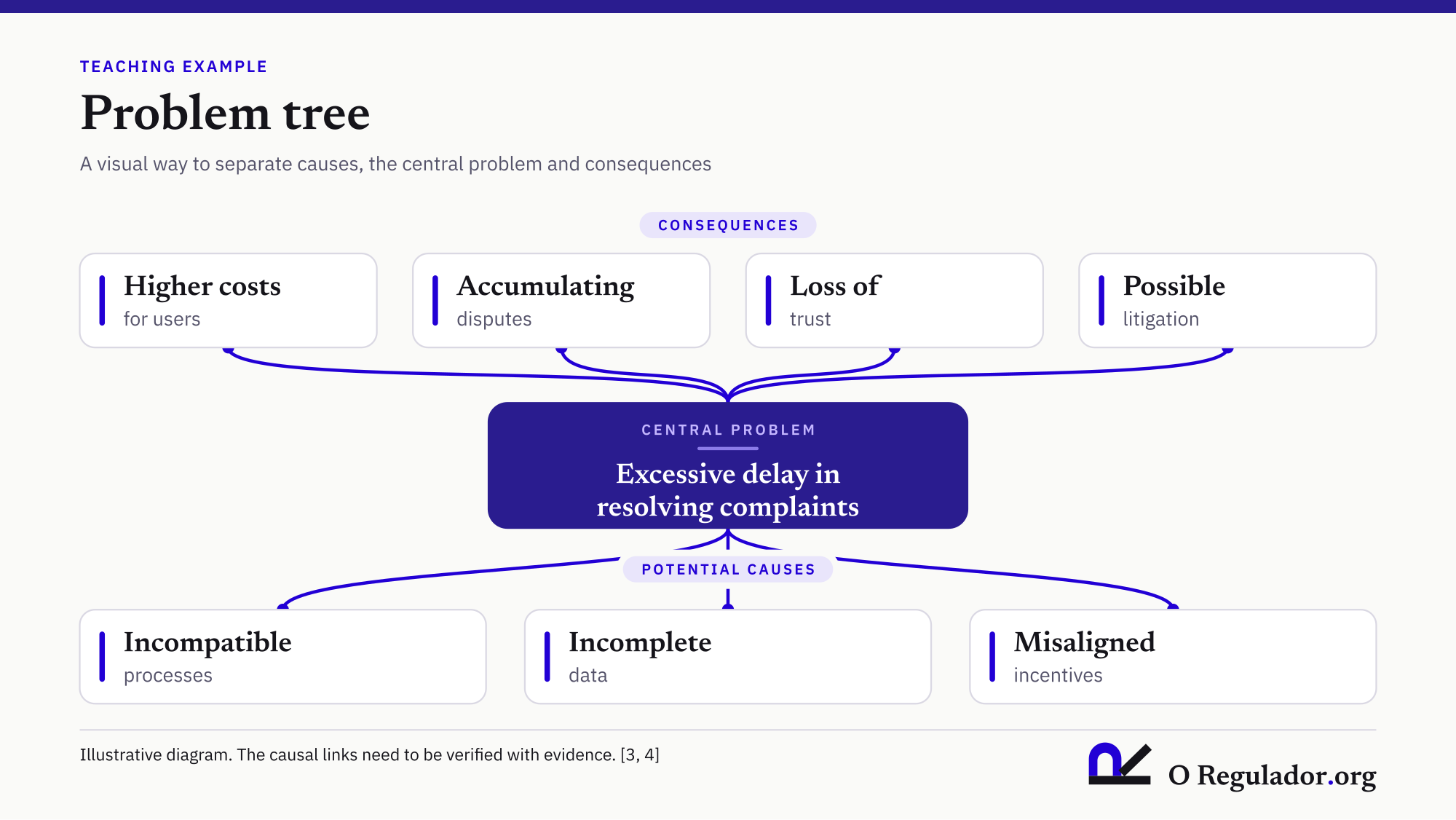
The links between these levels should represent relationships that can be justified. An attractive diagram does not prove causation, just as an expert workshop does not replace empirical evidence. A diagram is useful for showing where the hypotheses lie and where further investigation is needed [3][4].
There is another decisive question: which cause can the regulator actually change? An authority may be able to reduce the complexity of a form, but acting alone it is unlikely to change the population’s income or general educational attainment. The response must match the regulator’s powers and the causal mechanism identified.
5. Magnitude: the number that seems to explain things, but does not yet do so
The extent of a problem should not be presented merely as a sequence of impressive figures. Appropriate indicators, denominators, comparison periods and affected groups all matter.
In our hypothetical billing example, suppose complaints rose from 100,000 to 130,000 in a year, while the number of customer accounts increased from 10 million to 14 million. The absolute number of complaints grew by 30%, but the rate fell from 10 to approximately 9.3 complaints per thousand accounts. The interpretation changes.
Even the rate may not tell the whole story. A campaign to publicize complaint channels may increase reporting without any deterioration in service quality. A new classification system may alter a historical series. Some groups may report more because they face fewer barriers, while vulnerable consumers remain invisible in the data.
For this reason, measuring a problem’s extent requires, at a minimum, checking what is being measured, how stable the indicator has been over time and how it varies between groups. Wherever possible, it is useful to triangulate administrative records, surveys, inspections, market data and accounts from affected parties. A public consultation may reveal causes that the technical team had not considered, but the responses must not automatically be treated as a representative sample of the population [3][4].
A well-defined problem should be observable, bounded and open to testing against evidence. This does not mean that every effect must be expressed in currency or percentages. Risks to health, safety and rights may require rigorous qualitative evidence. What matters is explaining why the available information supports a conclusion and what remains uncertain.
6. Data do not become evidence on their own
There is a difference between presenting information and building a justification. A report may contain charts, interviews and studies without explaining what each actually establishes.
Rantala, Alasuutari and Kuorikoski propose understanding RIA as a process of evidential reasoning. The emphasis is on the link between observed data, explanatory hypotheses, causal mechanisms, expected future effects and uncertainties. On this view, adding more data or more sophisticated statistical techniques does not automatically produce stronger evidence [6].
Return once more to the hypothetical complaints. Hypothesis A says metering errors cause incorrect charges. Hypothesis B points to difficulties understanding the bill. Hypothesis C attributes part of the increase in complaints to the expansion of reporting channels. Each suggests different tests. Records of billing corrections help investigate A. Comprehension surveys and experiments with the presentation of information can assess B. Time series showing when complaint channels were introduced, combined with usage data, may help illuminate C.
A regulator does not need absolute certainty before acting. It needs to make clear what is known, where that knowledge comes from, what inference is being drawn and how the decision might change if a hypothesis proved false. Such transparency also enables affected parties to challenge the analysis constructively.
Responsible use of artificial intelligence can speed up the organization of this work. AI can help locate passages, compare arguments and identify missing documents. But it should not invent evidence, turn mere correlation into causation or assign statistical confidence to a conclusion that has not been tested.
7. A Brazilian case: when Anvisa changed the definition of the problem
A concrete example shows why the distinction between an undesirable situation, its causes and the regulator’s scope of action is worth preserving.
In its preliminary RIA on nutrition labeling, published in 2018, Brazil’s National Health Surveillance Agency (Agência Nacional de Vigilância Sanitária, Anvisa) initially formulated the problem as Brazilian consumers’ difficulty in using nutritional information. The report assembled material on the presentation of nutrition tables, nutritional knowledge, the information available and consumer behavior [7].
During the process, the agency received submissions through Public Call for Evidence No. 1/2018 (Tomada Pública de Subsídios nº 1/2018) and examined additional studies. In its September 2019 report, the team recognized that the initial diagnosis was too broad: using information to make food choices also depends on income, price, preferences, available time, education and personal circumstances, many of which lie outside the agency’s direct remit. The problem statement was therefore narrowed to Brazilian consumers’ difficulty in understanding nutrition labeling [8, section 2, pp. 36-39].
The change may appear merely semantic, but it was not. By narrowing the scope, the analysis brought the problem closer to causes that public health regulation could influence and reorganized the links between diagnosis, objectives and possible courses of action.
The final report identified, among other factors, difficulties seeing and reading the nutrition table, the volume of technical information, obstacles to comparing foods, messages that may mislead consumers, and shortcomings in nutrition education. Figure 2 of Anvisa’s 2019 report, on page 39, shows a problem tree with groups of causes and root causes. Figure 4 of that report, on page 48, addresses consequences. The objectives section recasts the purpose of intervention as making nutrition information easier to understand in support of food choices [8].
The process examined maintaining the existing rules, education and guidance initiatives, and changes to regulations. The conclusion that revising nutrition labeling would be relevant came after that clarification of the problem, not in place of it. In 2020, Anvisa adopted Collegiate Board Resolution (Resolução da Diretoria Colegiada, RDC) No. 429 and Normative Instruction (Instrução Normativa, IN) No. 75, introducing new rules for the presentation of nutritional information and front-of-package labeling [9].
Two qualifications matter. The first is that this case illustrates an improvement in the problem statement and in the internal coherence of regulatory reasoning; it does not, by itself, establish that all the anticipated effects of the new rules were achieved, which would require a later evaluation of outcomes. The second is that the 2019 report describes responses from consultation participants, and percentages based on those responses must not be presented as representative estimates for all Brazilian consumers [3][8].
The lesson is this: a sound RIA process must allow the very definition of the problem to be revised when new evidence emerges. If the diagnosis cannot be changed, public participation risks becoming merely a formal step.
8. Will the problem still exist if the regulator does nothing?
Once the problem has been defined, we still need to look ahead. What is likely to happen if no additional intervention is adopted?
This is the logic of the baseline scenario, also described in some contexts as the status quo or no-intervention scenario. It must not be mistaken for a snapshot of the present. Even without a new rule, the economy changes, technologies spread, courts make decisions, contracts expire, market participants adjust their behavior and existing regulations continue to have effects [2][3].
Imagine that difficulties in understanding a particular service are already declining because providers have begun adopting clearer formats. A regulatory obligation that would produce a 20-percentage-point improvement relative to the present could generate a much smaller additional benefit if, without that obligation, the market was already on course to improve by 15 points. These figures are hypothetical, but they illustrate the need to estimate the incremental effect of intervention rather than attribute to regulation every improvement that may occur in the future.
The reasoning also works in the opposite direction. A safety problem may grow as an activity expands, even if the current frequency of incidents is low. Ignoring that trend could lead the assessment to underestimate the need for action.
Constructing a baseline scenario deserves an article of its own, and it will be the subject of the next installment in this series. For now, the important point is that defining the problem also requires considering its expected evolution, not just its current state.
9. How can we tell whether a problem has been defined well?
The RIA Quality Indicator (Indicador de Qualidade da AIR, IQAIR), developed and used by Brazil’s National Water and Basic Sanitation Agency (Agência Nacional de Águas e Saneamento Básico, ANA), structures the assessment into 12 criteria and 24 subcriteria. The “Regulatory problem” criterion accounts for 15.9% of the total score and comprises five dimensions [10].
The table shows the official IQAIR weights, converted and rounded to a 100-point scale. Together they add up to the criterion’s 15.9 points.
| Dimension | Approximate weight in the overall score |
|---|---|
| Central problem | 4.52 points |
| Causes | 4.29 points |
| Consequences | 3.43 points |
| Expected evolution of the problem | 1.72 points |
| Graphic representation of the problem | 1.94 points |
Graphic representation is a subcriterion of ANA’s assessment methodology, not an autonomous textual requirement under item II of Article 6 of the Decree. The Decree establishes minimum elements, and the quality methodology examines how those elements were addressed [1][10].
Scoring is not a matter of searching for words. A report that mentions “causes” has not necessarily identified all relevant drivers. A problem tree may display incoherent relationships. And a concise, apparently precise problem statement may lack data capable of supporting it. Under ANA’s methodology, assessment is substantive: each subcriterion may be fully met, partially met or not met [10].
10. What the literature has found in Brazilian RIAs
Before turning to our own document collection, it is useful to see what published studies found when they evaluated regulatory reports.
Saab and Silva examined 21 RIAs from Brazilian federal regulatory agencies concerning decisions made between April 15 and December 31, 2021, using an assessment instrument with 50 criteria. Their findings were mixed: problem and objective statements performed relatively better, but important weaknesses remained in identifying causes, using evidence, measuring impacts and comparing alternatives [11].
For the identification of root causes, the study reported an average score equivalent to 7.6% of the maximum available for that criterion. This must be read carefully: it does not mean that only 7.6% of the RIAs identified root causes. The figure is the average performance normalized against the specific scoring rubric used in that study, in a small sample covering a defined period [11].
Another study, published in 2026 by Peci and colleagues, examined 355 RIAs from eleven federal agencies, produced between 2014 and 2021. The researchers assessed report quality and investigated how the formalization of procedures might influence RIA content. They found an association between overly standardized templates and lower analytical quality, whereas more strategic guidance documents were associated with better results [12]. This association does not establish that all templates are harmful or that there is a simple causal relationship between using a template and producing lower-quality assessments.
Both studies show why filling in fields is not the same as constructing an argument. A report may formally answer every question in a template and still fail to connect the phenomenon, its causes, the evidence and the alternatives. Conversely, a report organized differently may contain a robust substantive analysis.
These studies should not be confused with the documentary corpus examined for this article. Their periods, assessment instruments, inclusion criteria and units of observation differ. There is no basis for combining their figures or building a time series of quality scores without first harmonizing their methods.
11. A new document-based investigation: what 358 groups of reports allow us to observe
To illustrate this challenge in Brazilian regulatory practice, O Regulador.org assembled documents associated with RIAs from eleven federal regulatory agencies. The collection cataloged 507 files, including different versions and related documents. Preliminary reconciliation identified 358 provisional document groups, each represented by one processed file whose integrity was verified. Within this set, 238 documents had a document year between 2022 and 2026 [13].
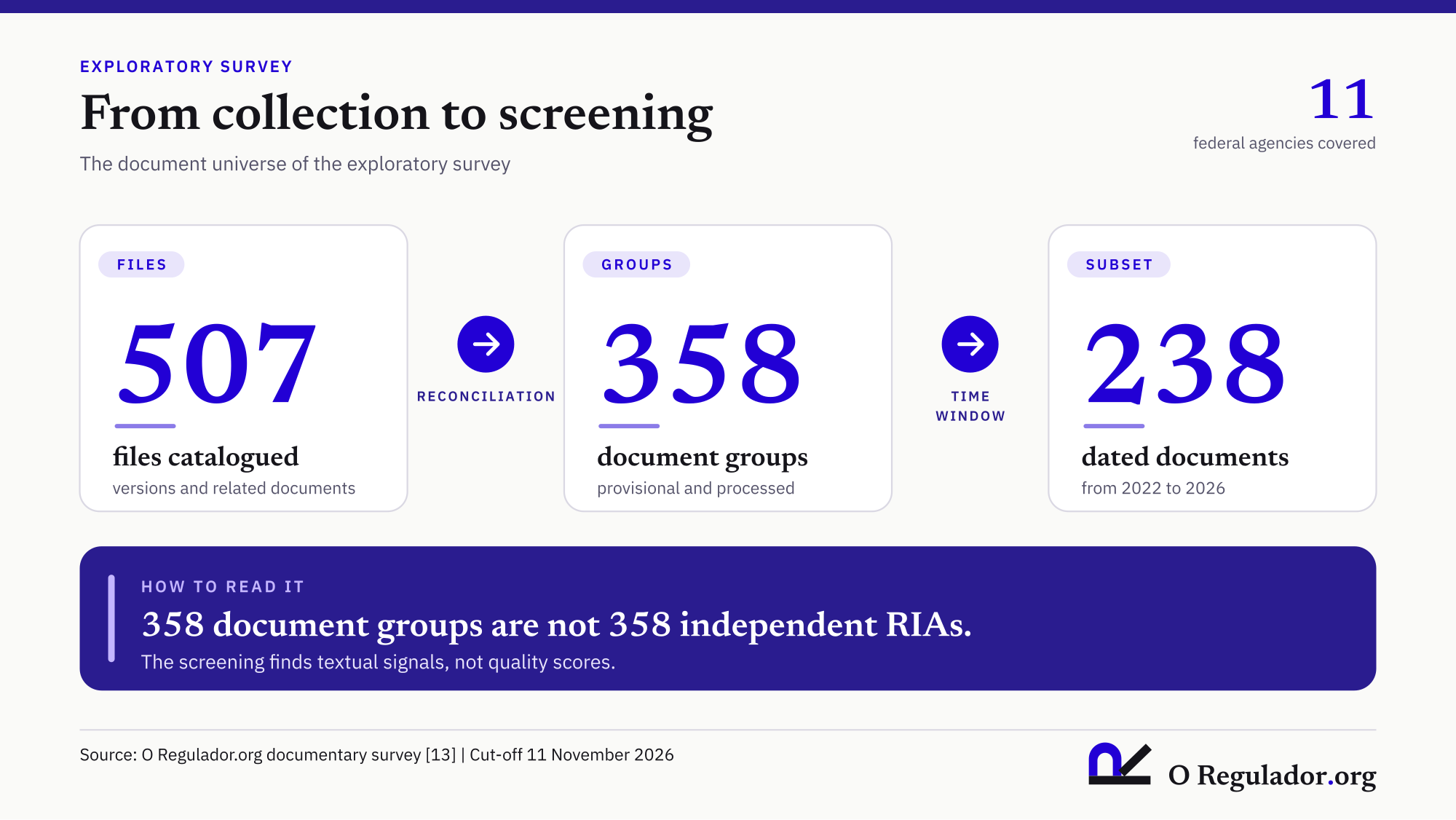
For the 238-document subset, automated screening identified the textual signals below. The presence of a term does not establish that a methodological requirement has been met.
| Textual signal detected automatically | Documents in the 238-document subset |
|---|---|
| Possible problem statement or dedicated problem field | 184 (77.3%) |
| Cause-related terms in the diagnostic passage | 93 (39.1%) |
| Consequence-related terms in the diagnostic passage | 84 (35.3%) |
| Textual indications of data or studies in the diagnosis | 140 (58.8%) |
| Reference to a problem tree or causal diagram in the document | 87 (36.6%) |
| Reference to the status quo or taking no action | 134 (56.3%) |
| Reference to the problem’s evolution or projections | 59 (24.8%) |
These are frequencies of textual signals, not rates of methodological compliance. A reference to a problem tree does not guarantee that the diagram is sound, while a cause substantiated by evidence may never be labeled a “cause.” Even the candidate problem statements include false positives. For that reason, the study did not assign IQAIR scores to the 358 units [13].
A qualitative pilot comprising 13 purposively selected studies allowed problem statements to be checked against the reports and relevant passages to be retrieved. Some problems were framed as observable situations, such as the risk of an activity being abandoned without proper safeguards or difficulties accessing a market. Others were framed as a need to define procedures, update rules or establish legal mechanisms. In some reports, the body of the analysis contained a richer social and economic diagnosis than the sentence chosen to state the problem.
The exploratory classification of those thirteen statements found five clear cases where the wording anticipated a solution, three intermediate cases and five without that indication. This distribution is not representative and does not establish the overall quality of those thirteen studies, much less of all 358 units. A poorly worded sentence does not automatically invalidate the entire analysis, and an impeccable sentence does not certify that the causes have been demonstrated [13].
The decision not to name individual agencies in the published examples is an editorial one. The internal dataset preserves the identity and origin of each file, as well as the possibility of auditing it. Anonymization reduces the risk that exploratory screening will be mistaken for an institutional ranking, although it does not remove the obligation to explain sources, limitations and methods.
What the investigation adds to the article is a methodological observation: the risk of confusing the problem with the policy instrument is not merely an abstraction found in international guidance. Different ways of framing problems can be found in actual Brazilian regulatory documents. The prevalence of inadequate diagnoses, however, can only be estimated after validated substantive coding, duplicate controls and consistent criteria have been applied.
12. Artificial intelligence can support assessment, but it cannot replace judgment
There is a contemporary temptation that resembles the mistake discussed at the beginning of this article: before evaluating the quality of the diagnosis, select an indicator that is easy to automate and treat it as a sufficient measure.
In our investigation, computational resources helped locate files, extract passages, detect expressions, preserve candidate page references and organize a review queue. This saves work and makes it possible to examine a larger corpus. Even so, finding the word “evidence” is not the same as evaluating evidence, finding “baseline scenario” does not show that the baseline was built properly, and finding “cause” does not demonstrate a causal relationship.
A responsible evaluation should retain the passage supporting each judgment, its page or section, the level of confidence, the technical justification and the possibility of review by another assessor. Wherever feasible, agreement between reviewers should be tested and disagreements recorded. AI can propose classifications and locate information, but responsibility for the conclusion remains with the person who validates it.
The principle applies equally to researchers and regulatory agencies. If we demand a verifiable chain of reasoning from the regulator, we cannot publish scores produced by an algorithm simply because they can be generated quickly in a spreadsheet.
13. Five questions that reveal whether an RIA has started well
Before discussing a draft resolution, it is worth putting the diagnosis through a short test of five questions.
The first is whether the undesirable situation would still exist if no new regulation were issued. If the answer is no, the statement may describe only an intention to regulate. The second is who experiences the problem, in what way and on what scale, because a generic category such as “users” may conceal very different impacts across groups. The third is what explains the phenomenon and what evidence supports that explanation, keeping hypotheses, stakeholders’ views and demonstrated mechanisms apart.
The fourth is what is likely to happen without additional intervention. A sound comparison needs a plausible baseline trajectory, not a frozen picture of the present. The fifth is whether the alternatives actually address the identified causes. If every option merely changes the intensity of the same regulatory obligation, the diagnosis may have closed the discussion too early.
Answering these questions well does not force the regulator to select a particular solution. It enables something more important: the decision can be understood, challenged and later evaluated against the results it was intended to achieve.
A regulatory problem is not, by definition, the absence of a rule. It may be information that people cannot understand, poorly allocated risks, perverse economic incentives, a coordination failure or an existing rule that no longer achieves its purpose. Sometimes a new regulation will be necessary. In other cases, it will be enough to enforce what already exists more effectively, remove an obstacle, improve information or accept that additional public intervention would add little.
A sound RIA must establish which of these situations exists before recommending a response. That is what turns regulation into a decision that can be defended with reasons, evidence and transparency.
In the next article in this series, the investigation turns to the baseline scenario: how can we estimate what would happen without intervention, and avoid crediting regulation with effects that would have occurred anyway?
Methodological note
The O Regulador.org documentary survey has a cutoff date of November 11, 2026. The 358 records represent provisional document groups drawn from 507 files, not a certified census of RIAs. The subset of 238 documents covers those with a document year from 2022 to 2026. Published percentages measure occurrences of expressions or candidate fields in the text and are subject to both false positives and false negatives. The thirteen-case pilot was purposively selected and is not a probability sample. The research did not produce IQAIR scores for the corpus or a ranking of agencies. Document identities are retained in the internal inventory to allow auditing. Scientific and legal sources are cited below; the internal report [13] is the primary source for the new figures presented here and remains subject to independent review.
References
- BRAZIL. Decreto nº 10.411, de 30 de junho de 2020. [Decree No. 10,411 of June 30, 2020: Regulates regulatory impact assessment, as provided for in Article 5 of Law No. 13,874 of September 20, 2019, and Article 6 of Law No. 13,848 of June 25, 2019]. Updated text. Articles 2, 5 and 6. In Portuguese. Available at: https://www2.camara.leg.br/legin/fed/decret/2020/decreto-10411-30-junho-2020-790371-normaatualizada-pe.html. Accessed on: November 11, 2026.
- OECD. Regulatory Impact Assessment. OECD Best Practice Principles for Regulatory Policy. Paris: OECD Publishing, 2020. Especially Chapter 2. Available at: https://doi.org/10.1787/7a9638cb-en. Accessed on: November 11, 2026.
- EUROPEAN COMMISSION. Better Regulation Toolbox. December 2025 edition. Tool No. 13, How to analyse problems, pp. 90-102. Available at: https://commission.europa.eu/law/law-making-process/better-regulation/better-regulation-guidelines-and-toolbox/better-regulation-toolbox_en. Accessed on: November 11, 2026.
- BRAZIL. Office of the Chief of Staff of the Presidency (Casa Civil). Diretrizes Gerais e Guia Orientativo para Elaboração de Análise de Impacto Regulatório. [General Guidelines and Guidance for Preparing Regulatory Impact Assessments]. Brasília, 2018. In Portuguese. Available at: https://www.gov.br/casacivil/pt-br/assuntos/governanca/regulacao/apresentacao-regulacao-pasta/comite-interministerial-de-governanca-aprova-as-diretrizes-gerais-e-roteiro-analitico-sugerido-para-analise-de-impacto-regulatorio-diretrizes-air-e-o-guia-orientativo-para-elaboracao-de-analise-de-impacto-regulatorio-guia-air/diretrizes_guia_air_cig_11junho2018.pdf/view. Accessed on: November 11, 2026.
- STONE, Deborah A. Causal Stories and the Formation of Policy Agendas. Political Science Quarterly, vol. 104, no. 2, pp. 281-300, 1989. Available at: https://doi.org/10.2307/2151585. Accessed on: November 11, 2026.
- RANTALA, Kati; ALASUUTARI, Noora; KUORIKOSKI, Jaakko. The logic of regulatory impact assessment: From evidence to evidential reasoning. Regulation & Governance, vol. 18, no. 2, pp. 534-550, 2024. Available at: https://doi.org/10.1111/rego.12542. Accessed on: November 11, 2026.
- ANVISA. Relatório Preliminar de Análise de Impacto Regulatório sobre Rotulagem Nutricional. [Preliminary Regulatory Impact Assessment Report on Nutrition Labeling]. Brasília, May 2018. Initial formulation and causes considered. In Portuguese. Available at: Preliminary report in PDF (Anvisa). Accessed on: November 11, 2026.
- ANVISA. Relatório de Análise de Impacto Regulatório sobre Rotulagem Nutricional. [Regulatory Impact Assessment Report on Nutrition Labeling]. Brasília, September 2019. Especially section 2, pp. 36-39; Figure 2, p. 39; Figure 4, p. 48; section 5, pp. 53-54. In Portuguese. Available at: https://www.gov.br/anvisa/pt-br/assuntos/regulamentacao/air/analises-de-impacto-regulatorio/2019/relatorio-de-analise-de-impacto-regulatorio-sobre-rotulagem-nutricional.pdf. Accessed on: November 11, 2026.
- ANVISA. Rotulagem nutricional: novas normas, RDC nº 429/2020 e IN nº 75/2020. [Nutrition labeling: new rules, RDC No. 429/2020 and IN No. 75/2020]. Official explanatory page, with links to the legislation. In Portuguese. Available at: https://www.gov.br/anvisa/pt-br/assuntos/alimentos/rotulagem/rotulagem-nutricional. Accessed on: November 11, 2026.
- BRAZILIAN NATIONAL WATER AND BASIC SANITATION AGENCY (ANA). Indicador de Qualidade da AIR (IQAIR). [RIA Quality Indicator, IQAIR]. Official methodology, criteria and weights. In Portuguese. Available at: https://www.gov.br/ana/pt-br/assuntos/governanca-regulatoria/analise-de-impacto-regulatorio-air/qair. Accessed on: November 11, 2026.
- SAAB, Flavio; SILVA, Suylan de Almeida Midlej e. Qual a qualidade da análise de impacto regulatório elaborada por agências reguladoras do Brasil? [How Good Are Regulatory Impact Assessments Produced by Brazilian Regulatory Agencies?]. Revista de Administração Pública, vol. 56, no. 4, pp. 529-549, 2022. Especially Table 1. In Portuguese. Available at: https://doi.org/10.1590/0034-761220220111. Accessed on: November 11, 2026.
- PECI, Alketa; PILLA, Leonardo Henrique Lima de; SAAB, Flavio; VIANA, Luna Bouzada Flores; TRIGO, Sergio Alonso. “Hitting the Target, but Missing the Point” in Regulatory Impact Assessments: Does Bureaucratization Lead to Better RIAs? Regulation & Governance, first published online May 12, 2026. Available at: https://doi.org/10.1111/rego.70166. Accessed on: November 11, 2026.
- O REGULADOR.ORG. Definição do problema regulatório em AIRs federais: varredura documental e análise de triagem. [Defining the Regulatory Problem in Federal RIAs: Documentary Survey and Screening Analysis]. Internal Phase 2 methodological report, 358 document groups, cutoff November 11, 2026. Dataset and extraction procedures retained for auditing; findings remain exploratory.
The opinions and analyses expressed in this article are personal and do not represent the institutional positions, decisions or interpretations of the Brazilian Electricity Regulatory Agency (ANEEL).
How to cite this article
ALCÂNTARA, Márcio. The Regulatory Problem Is Not a Missing Rule. Regulador.org, 2026. Available at: https://www.regulador.org/en/2026/11/12/regulatory-problem-not-missing-rule/. Accessed on: Nov. 12, 2026.
Dr. Márcio Alcântara
Electrical engineer with a master's degree and a PhD from UNICAMP. A civil servant at ANEEL since 2008. Writes about regulation as a discipline: how public decisions are built, what evidence supports them, and how they can be more transparent.